The Answer-First Paradigm: Structuring Inverted Pyramid Content for Direct LLM Retrieval
Why buried answers fail in generative search: how inverted pyramid structure and 40–60 word answer blocks secure direct AI citations in ChatGPT, Perplexity, and Google AI Overviews.
By J. Pannu · · 14 min read
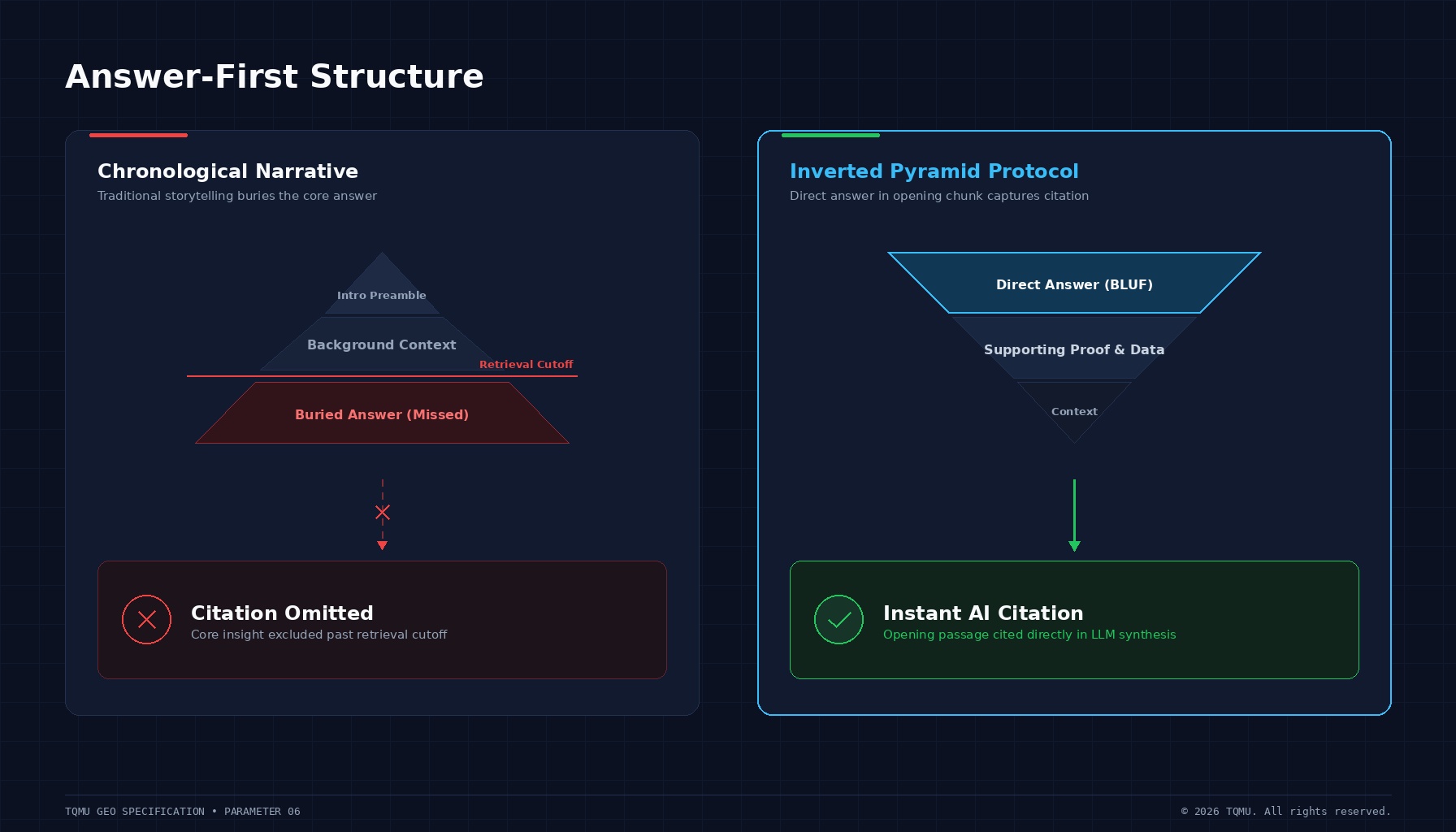
Executive Summary: Why Direct Answers Win in AI Search
Traditional search engine optimization (SEO) taught website owners to write long, narrative articles. The goal was to build topical authority, increase time on page, and keep visitors scrolling past advertisements. Writers routinely buried the main takeaway at the bottom of the article after several paragraphs of historical background and introductory pleasantries.
In generative engine optimization (GEO), that habit actively harms your visibility.
AI search engines—including Perplexity, ChatGPT Search, and Google AI Overviews—do not read or cite entire web pages at once. When someone asks an AI engine a question, its retrieval system scans the web, slices pages into small text segments called passages or chunks, and scores each chunk independently. The engine selects the single passage that answers the query with the highest clarity and factual density, then uses it to write its synthesized answer.
The answer-first paradigm requires placing a clear, standalone, 40–60 word answer directly beneath your main heading (<h1> or <h2>) before explaining context, history, or secondary details. This approach borrows from journalism's inverted pyramid and military Bottom Line Up Front (BLUF) communication. When your opening paragraph delivers the complete core answer right away, AI engines can easily extract it, quote it, and cite your website as the primary source.
How AI Search Engines Read and Extract Web Content
To understand why traditional web writing fails in AI search, you need to see how modern retrieval-augmented generation (RAG) pipelines process your pages.
+---------------------------------------------------------------------------------------------------+
|                                  HOW AI ENGINES EXTRACT YOUR CONTENT                              |
+---------------------------------------------------------------------------------------------------+
|  1. PAGE INGESTION           The AI crawler reads your raw HTML and strips menus, ads and footers |
|                                                                                                   |
|  2. PASSAGE SLICING          The text is divided into bite-sized chunks (typically 250–500 words) |
|                                                                                                   |
|  3. RELEVANCE SCORING        Each chunk gets scored for how directly it answers the user's query  |
|                                                                                                   |
|  4. CANDIDATE SELECTION      Only the top-scoring chunks are passed into the AI language model   |
|                                                                                                   |
|  5. ANSWER SYNTHESIS         The AI writes its final response and links to the source chunks      |
+---------------------------------------------------------------------------------------------------+
1. Document Chunking: Why Paragraph Order Matters
AI engines cannot process a 3,000-word article as a single input when searching millions of sites simultaneously. Instead, their systems break your content into small text blocks, known as chunks.
Most retrieval systems split text at natural paragraph breaks. If your article opens with two paragraphs of conversational throat-clearing ("In today's fast-moving business world, companies face unprecedented decisions..."), that first text chunk contains zero actionable information.
The AI system scores chunk #1, finds no concrete answer, and moves on. Even if paragraph six contains an outstanding, authoritative answer, your page may already be dropped from the candidate list before that later paragraph is ever evaluated.
2. Semantic Density: The Inference Behind Relevance Matching
AI models measure the semantic similarity between what a user asks and what your text says. You can think of this as measuring the density of useful information in a given paragraph.
Here is the practical inference for site owners:
- Diluted Paragraph: If a 250-word paragraph contains 25 words of real answer surrounded by 225 words of filler, its relevance score drops sharply. The AI system interprets the paragraph as mostly conversational noise.
- Concentrated Paragraph: If a 50-word paragraph delivers the definition, the key metric, and the core operational rule in three clean sentences, its relevance score hits maximum. The AI recognizes an immediate, authoritative match.
When you front-load the answer, you concentrate your factual density in the exact spot where AI retrieval scrapers begin reading.
3. The "Lost in the Middle" Dilemma
Academic research from Stanford University and UC Berkeley (Liu et al., 2023) identified a clear pattern in how language models process information, termed the "Lost in the Middle" phenomenon [1]. When an AI system evaluates several pieces of text, it pays the closest attention to information placed at the very beginning and the very end of the text block. Information buried in the middle frequently gets overlooked.
Reranking models follow the same rule. If an editor forces readers to scroll past three sections of background before reaching the solution, the search algorithm often discards the page in favor of a competitor who stated the conclusion in their first sentence.
Proven Precedents: Journalism, Web Usability, and Defense Communication
Putting the answer first is not a temporary search engine trick. It is the gold standard of high-efficiency communication across journalism, web usability, and military operations.
+---------------------------------------------------------------------------------------------------+
|                               THREE PROVEN COMMUNICATION MODELS                                   |
+---------------------------------------------------------------------------------------------------+
|  JOURNALISM (1860s)          The Inverted Pyramid: Put the who, what and why in the lead sentence |
|                                                                                                   |
|  WEB USABILITY (1990s)       NN/g F-Pattern: Readers scan the top and abandon long introductions   |
|                                                                                                   |
|  DEFENSE BRIEFINGS (1980s)   Military BLUF: Bottom Line Up Front for immediate executive clarity  |
+---------------------------------------------------------------------------------------------------+
1. The Journalistic Inverted Pyramid
As media historian Horst Pöttker detailed in Journalism Studies (2003), news reporters in the nineteenth century relied on telegraph wires to file battlefield reports [2]. Because telegraph lines frequently failed mid-transmission, reporters could not afford to build suspense. They structured articles with three tiers:
- The Lead: The most critical news (who, what, where, when, why) in the opening sentence.
- The Body: Key supporting evidence, statistics, and stakeholder quotes.
- The Background: Historical context and secondary details.
AI retrieval crawlers face a digital equivalent of a telegraph cutoff: limited context windows and strict snippet budgets. An article that states the outcome upfront survives any extraction cutoff.
2. Jakob Nielsen's Web Usability Research
In 1996, usability researcher Jakob Nielsen published his landmark study "Inverted Pyramids in Cyberspace" through the Nielsen Norman Group [3]. His research showed that online audiences do not read web pages like books; they scan them. Subsequent eyetracking studies by Pernice (2017) demonstrated that users read in an "F-shaped pattern," focusing heavily on the first two lines of text before scanning down the left margin [4].
Nielsen pointed out that academic-style writing—which moves slowly through literature reviews before reaching conclusions—causes web visitors to bounce. An answer-first layout aligns directly with natural human scanning behavior.
3. Military Communication: Bottom Line Up Front (BLUF)
The United States military formalizes this in Field Manual FM 6-22 (Army Leadership) through the Bottom Line Up Front (BLUF) standard. In military staff writing, every memorandum or briefing must open with the conclusion, decision, or core finding in sentence one. Background details appear only after the bottom line is established.
AI search engines evaluate pages with the same urgency as an executive reader: they reward sources that state the bottom line immediately without wading through fluff.
4. Empirical Proof from Princeton and Georgia Tech (Aggarwal et al., 2024)
In the research paper "GEO: Generative Engine Optimization" presented at ACM KDD 2024, researchers Pranjal Aggarwal, Vishvak Murahari, and their co-authors tested various content strategies against leading AI engines [5].
Their benchmark proved that traditional keyword repetition had virtually no positive effect on AI visibility. In contrast, restructuring content to deliver clear, fact-based answers with supporting citations and statistical proof boosted visibility in generative search responses by up to 40%. Direct, evidence-backed answers consistently outperform narrative prose.
Anatomy of an Answer-First Block: A Practical Template
To implement the answer-first framework on your website, follow this simple structural formula for every primary topic and sub-heading.
+---------------------------------------------------------------------------------------------------+
|                                  THE ANATOMY OF AN ANSWER-FIRST BLOCK                             |
+---------------------------------------------------------------------------------------------------+
|                                                                                                   |
|  [TARGET HEADING]           A clear question or topic name                                        |
|                             Example: "What is Maximum Transmission Unit (MTU)?"                   |
|                                                                                                   |
|  [THE 50-WORD ANSWER]       Direct definition + primary metric + operational boundary condition  |
|                             "Maximum Transmission Unit (MTU) is the largest data packet, measured |
|                             in bytes, that a network interface can transmit without fragmentation.|
|                             Standard Ethernet networks enforce a default MTU of 1,500 bytes.      |
|                             Exceeding this threshold causes routers to break packets apart or     |
|                             drop them if the Don't Fragment flag is set."                         |
|                                                                                                   |
|  [SUPPORTING DATA TABLE]    Structured proof table comparing options or standards                 |
|                             +-----------------+--------------+-----------------------------+      |
|                             | Connection Type | Standard MTU | Typical Application         |      |
|                             +-----------------+--------------+-----------------------------+      |
|                             | Ethernet v2     | 1,500 bytes  | Standard enterprise traffic |      |
|                             | Jumbo Frames    | 9,000 bytes  | High-speed storage networks |      |
|                             +-----------------+--------------+-----------------------------+      |
|                                                                                                   |
|  [IN-DEPTH EXPLANATION]     Technical mechanics, step-by-step setup, and background context       |
|                                                                                                   |
+---------------------------------------------------------------------------------------------------+
The 4-Step Answer Formula
Write your opening paragraph using four distinct elements:
- State the entity and its category: Name the subject clearly without using ambiguous pronouns like "It" or "This."
- Explain its core function: Use active verbs to state what the subject does.
- Include a concrete benchmark or number: Give readers and AI crawlers an exact metric, percentage, timeframe, or standard value.
- State the primary constraint or boundary: Clarify when or where this definition applies.
Before (Narrative SEO Style):
"Throughout the history of computer networking, system administrators have grappled with the question of packet sizing. In the early days of telecommunications, different hardware manufacturers created various proprietary formats. As internet protocols standardized, engineers recognized that establishing unified thresholds was critical for network performance. Today, network teams frequently discuss MTU when optimizing switches."
(62 words, zero practical answers, unusable by an AI search engine).
After (Answer-First GEO Style):
"Maximum Transmission Unit (MTU) is the largest data packet, measured in bytes, that a network interface can transmit without fragmentation. Standard Ethernet networks enforce a default MTU of 1,500 bytes. Packets exceeding this size require router fragmentation or are dropped when the Don't Fragment rule is active."
(48 words, immediate definition, standard value, clear operational constraint).
Real-World B2B Examples Across Three Industries
Here is how B2B companies in different sectors can transform weak introductory prose into high-performing answer-first passages.
1. Enterprise SaaS: Cache Invalidation
| Content Element | Traditional Approach | Answer-First GEO Approach |
|---|---|---|
| Section Heading | <h2>Understanding Modern Caching Concepts</h2> |
<h2>How Does Stale-While-Revalidate Caching Work?</h2> |
| Opening Sentence | "Caching is often cited as one of the hardest challenges in software architecture." | "stale-while-revalidate is an HTTP Cache-Control directive that serves existing cached data to the user immediately while asynchronously fetching updated content in the background." |
| Technical Proof | Mentioned vaguely in paragraph 4. | Sentence 2 gives the exact header syntax: Cache-Control: max-age=600, stale-while-revalidate=30. |
| Search Engine Outcome | AI crawler sees no direct answer and skips the passage. | Extracted as the direct quoted explanation in AI Overviews. |
2. Corporate Compliance: ISO 27001 Access Controls
| Content Element | Traditional Approach | Answer-First GEO Approach |
|---|---|---|
| Section Heading | <h2>Our Security Journey and Philosophy</h2> |
<h2>What Are ISO 27001:2022 Access Control Requirements?</h2> |
| Opening Sentence | "We take security seriously and have invested in a culture of compliance." | "ISO/IEC 27001:2022 Control 5.15 requires organizations to grant, modify, and revoke digital access rights based on defined role-based policies and the principle of least privilege." |
| Evidence Placement | Buried inside a downloadable PDF. | Displayed immediately in a comparison table beneath the opening definition. |
| Search Engine Outcome | Ignored as generic marketing copy. | Cited by AI search tools evaluating enterprise security standards. |
3. Fintech & Banking: Payment Settlement Timelines
| Content Element | Traditional Approach | Answer-First GEO Approach |
|---|---|---|
| Section Heading | <h2>The Changing World of Business Payments</h2> |
<h2>What Is the Settlement Timeline for FedNow Instant Payments?</h2> |
| Opening Sentence | "Commercial payment systems have seen remarkable advances over recent decades." | "The FedNow Service clears interbank transfers and settles funds in real time within seconds, operating 24 hours a day, 365 days a year." |
| Specific Metrics | "Fast transfers" with no numbers. | States the specific transaction cap ($500,000 standard limit) and sub-second settlement speed. |
| Search Engine Outcome | Filtered out in favor of banking documentation. | Surfaced as the definitive answer for B2B payment queries. |
Clean HTML and Schema Markup for Web Teams
You do not need complex web development to support answer-first writing. A few clean HTML tags ensure that search crawlers parse your structure without confusion.
1. Semantic Article Structure
Use standard HTML tags so crawlers recognize headings and lead summaries:
<article>
  <header>
    <h1>Configuring Content Security Policy Headers</h1>
    <p class="lead">
      A Content Security Policy (CSP) is an HTTP header that restricts which scripts,
      stylesheets, and images a browser can load for a web page. It prevents Cross-Site
      Scripting (XSS) and unauthorized data injection by restricting assets to approved domains.
    </p>
  </header>

  <section id="default-directive">
    <h2>What Does the CSP default-src Directive Control?</h2>
    <p>
      The <code>default-src</code> directive acts as the automatic fallback for all resource
      types that are not explicitly assigned their own policy. Setting
      <code>default-src 'self'</code> blocks any script, font, or frame hosted outside your
      own domain unless you add an exception.
    </p>
  </section>
</article>
2. Definition Lists for Technical Terms
When defining terms, use HTML definition lists (<dl>, <dt>, <dd>). AI parsers interpret these as direct key-value pairs:
<dl>
  <dt><strong>Time to First Byte (TTFB)</strong></dt>
  <dd>
    The time in milliseconds from when a user's browser requests a page until the server
    sends the first byte of data. A healthy target is under 200 milliseconds.
  </dd>

  <dt><strong>Cumulative Layout Shift (CLS)</strong></dt>
  <dd>
    A Core Web Vital metric measuring visual page stability. A score under 0.1 confirms
    that page elements do not shift unexpectedly while loading.
  </dd>
</dl>
3. Structured Data Reinforcement (JSON-LD)
Mirror your opening definition in a Schema.org TechArticle or DefinedTerm block. This gives AI search engines both human-readable prose and machine-readable structured data:
{
  "@context": "https://schema.org",
  "@graph": [
    {
      "@type": "TechArticle",
      "@id": "https://www.tqmu.com/blog/answer-first-content-structure-geo#article",
      "headline": "The Answer-First Paradigm: Structuring Inverted Pyramid Content for Direct LLM Retrieval",
      "description": "A guide for site owners on structuring web articles using inverted pyramid principles to maximize citations in AI search engines.",
      "author": {
        "@type": "Person",
        "name": "J. Pannu"
      },
      "publisher": {
        "@type": "Organization",
        "name": "TQMU",
        "url": "https://www.tqmu.com"
      },
      "about": [
        {
          "@type": "DefinedTerm",
          "name": "Answer-First Structure",
          "description": "A web content structure that places an explicit 40-to-60-word answer directly beneath headings to maximize passage extraction by AI search engines."
        }
      ]
    }
  ]
}
Four Content Mistakes That Cause AI Search Dropouts
Review your existing blog posts and resource hubs for these four common publishing habits:
+---------------------------------------------------------------------------------------------------+
|                                  FOUR COSTLY CONTENT MISTAKES                                     |
+---------------------------------------------------------------------------------------------------+
|  1. THE EMPTY INTRO          Writing generic opening filler that provides no factual substance    |
|                                                                                                   |
|  2. THE MYSTERY ARTICLE      Saving your main recommendation for the final conclusion             |
|                                                                                                   |
|  3. ACCORDION HIDING         Locking primary definitions inside JavaScript dropdowns or tabs      |
|                                                                                                   |
|  4. PRONOUN CONFUSION        Starting paragraphs with "It helps you..." instead of naming the tool|
+---------------------------------------------------------------------------------------------------+
1. The Empty Introductory Paragraph
- The Issue: Opening with generic platitudes ("In the modern digital landscape, efficiency is more important than ever...").
- Why It Fails: It wastes the opening passage on words that carry no search relevance. The crawler scores your first chunk as low-value and ignores it.
- The Fix: Delete introductory throat-clearing. Start immediately with what the topic is, how it works, and why it matters.
2. Saving the Answer for the Conclusion
- The Issue: Writing like a mystery novelist who holds back the big reveal until the final paragraph.
- Why It Fails: AI engines prioritize the earliest clear passage they encounter. If your solution appears on paragraph eight, a competing site that put its answer on paragraph one will win the citation.
- The Fix: State the solution in the opening sentence. Use the rest of the article to prove, defend, and demonstrate how to implement it.
3. Hiding Answers Behind Clickable Accordions
- The Issue: Putting definitions or pricing answers inside interactive dropdown tabs that require a user click to expand.
- Why It Fails: Many AI web scrapers do not run full browser scripts or simulate user clicks. If your content requires JavaScript to become visible in the HTML document, the crawler may miss it completely.
- The Fix: Render primary answers directly in standard server-rendered HTML paragraphs.
4. Ambiguous Pronouns
- The Issue: Heading: "What is Redis?" Followed by: "It is widely adopted across high-traffic applications because it is fast."
- Why It Fails: When an extraction model pulls that sentence as a standalone chunk, the word "It" is ambiguous. The model cannot guarantee what "It" refers to without adjoining text.
- The Fix: Always name the noun in the opening sentence: "Redis is an open-source, in-memory data store used as a database, cache, and message broker."
Pre-Publish Editorial Checklist
Before publishing any new article or landing page, run through this five-point audit:
- Word Count: The summary paragraph beneath your
<h1>contains between 40 and 60 words. - Definitive First Sentence: Sentence one defines the core topic without introductory fluff.
- No Unanchored Pronouns: The actual entity name appears within the first eight words of the lead paragraph.
- Immediate Proof: A structured data table or verified metric follows the summary paragraph.
- HTML Delivery: The answer appears in standard server-rendered HTML text, not inside a collapsed script or image.
Authoritative References & Standards
- Liu, N. F., Lin, K., Hewitt, J., Paranjape, A., Bevilacqua, M., Petroni, F., & Liang, P. (2023). "Lost in the Middle: How Language Models Use Long Contexts." arXiv preprint arXiv:2307.03172. Stanford University, UC Berkeley, Samaya AI. https://arxiv.org/abs/2307.03172
- Pöttker, H. (2003). "News and its communicative quality: the inverted pyramid—when and why did it appear?" Journalism Studies, 4(4), 501–511. DOI: 10.1080/1461670032000136596
- Nielsen, J. (1996). "Inverted Pyramids in Cyberspace." Nielsen Norman Group. https://www.nngroup.com/articles/inverted-pyramids-in-cyberspace/
- Pernice, K. (2017). "F-Shaped Pattern of Reading on the Web: Misunderstood, But Still Relevant (Even on Mobile)." Nielsen Norman Group. https://www.nngroup.com/articles/f-shaped-pattern-reading-web-content/
- Aggarwal, P., Murahari, V., Rajpurohit, T., Kalyan, A., Narasimhan, K., & Deshpande, A. (2024). "GEO: Generative Engine Optimization." Proceedings of the 30th ACM SIGKDD Conference on Knowledge Discovery and Data Mining (KDD '24), 3671–3681. DOI: 10.1145/3637528.3671900; arXiv: 2311.09735
- United States Department of the Army. (2006). Army Leadership: Competent, Confident, and Agile. Field Manual FM 6-22 (formerly FM 22-100). Washington, DC: Headquarters, Department of the Army.
- Karpukhin, V., Oğuz, B., Min, S., Lewis, P., Wu, L., Edunov, S., Chen, D., & Yih, W. (2020). "Dense Passage Retrieval for Open-Domain Question Answering." Proceedings of the 2020 Conference on Empirical Methods in Natural Language Processing (EMNLP), 6769–6781. DOI: 10.18653/v1/2020.emnlp-main.550
- W3C HTML Working Group. (2021). HTML Review Draft: Semantic Structure and Text-Level Elements. World Wide Web Consortium. https://www.w3.org/TR/html52/
Frequently asked questions
Will placing answers upfront increase our bounce rate?
- No. Empirical studies from Nielsen Norman Group show that web visitors scan pages to confirm they are in the right place. An immediate, accurate answer establishes credibility within seconds. Rather than bouncing, readers stay on the page to examine supporting data, implementation steps, and pricing details.
What is the ideal length for an opening answer block?
- Between 40 and 60 words (roughly two to three clean sentences). Answers shorter than 30 words often lack practical nuance or boundary conditions. Answers exceeding 70 words run the risk of being trimmed mid-thought by search engine passage extractors.
Does answer-first writing help or hurt traditional Google SEO?
- It helps both. Traditional Google search uses featured snippets and passage ranking, both of which favor concise, well-structured definitions. AI search engines use those same clear passages to generate synthesized summaries. One clean answer-first block serves both ranking algorithms simultaneously.
Should every sub-heading (H2 and H3) also use an answer-first structure?
- Yes. Every major section should work like a standalone mini-article. When an AI search engine receives a specific question, it often pulls an excerpt from an `<h2>` section halfway down your page. If that section starts with its own clear answer, it is much more likely to be selected.
Can we keep our detailed storytelling and case studies?
- Yes. Answer-first does not mean publishing short, shallow articles. It simply changes the order of information. You still provide in-depth case studies, edge cases, and code walk-throughs; you just place the bottom-line takeaway at the beginning of each section rather than at the end.
How quickly do AI search engines detect these changes on updated pages?
- Once search crawlers re-index your updated HTML, changes typically reflect in AI retrieval databases within days to a few weeks, depending on crawl frequency. Submitting an updated XML sitemap with accurate `lastmod` timestamps helps accelerate discovery.
Can answers be placed inside FAQ dropdowns?
- We recommend keeping your primary topic answers in standard open text. If you use FAQ accordions, ensure your web team renders them in the initial static HTML payload (for example using the HTML5 `<details open>` tag) so search bots can read them without executing JavaScript click events.
About the author
J. Pannu · Founder
Connect on LinkedInKeep reading

Search Isn't Disappearing, but Your Clicks Are
SEO vs GEO key metrics and outlook, 2026–2030. Updated November 2026 with research, analyst and reference sources only.
Nov 16, 2026 · 4 min read
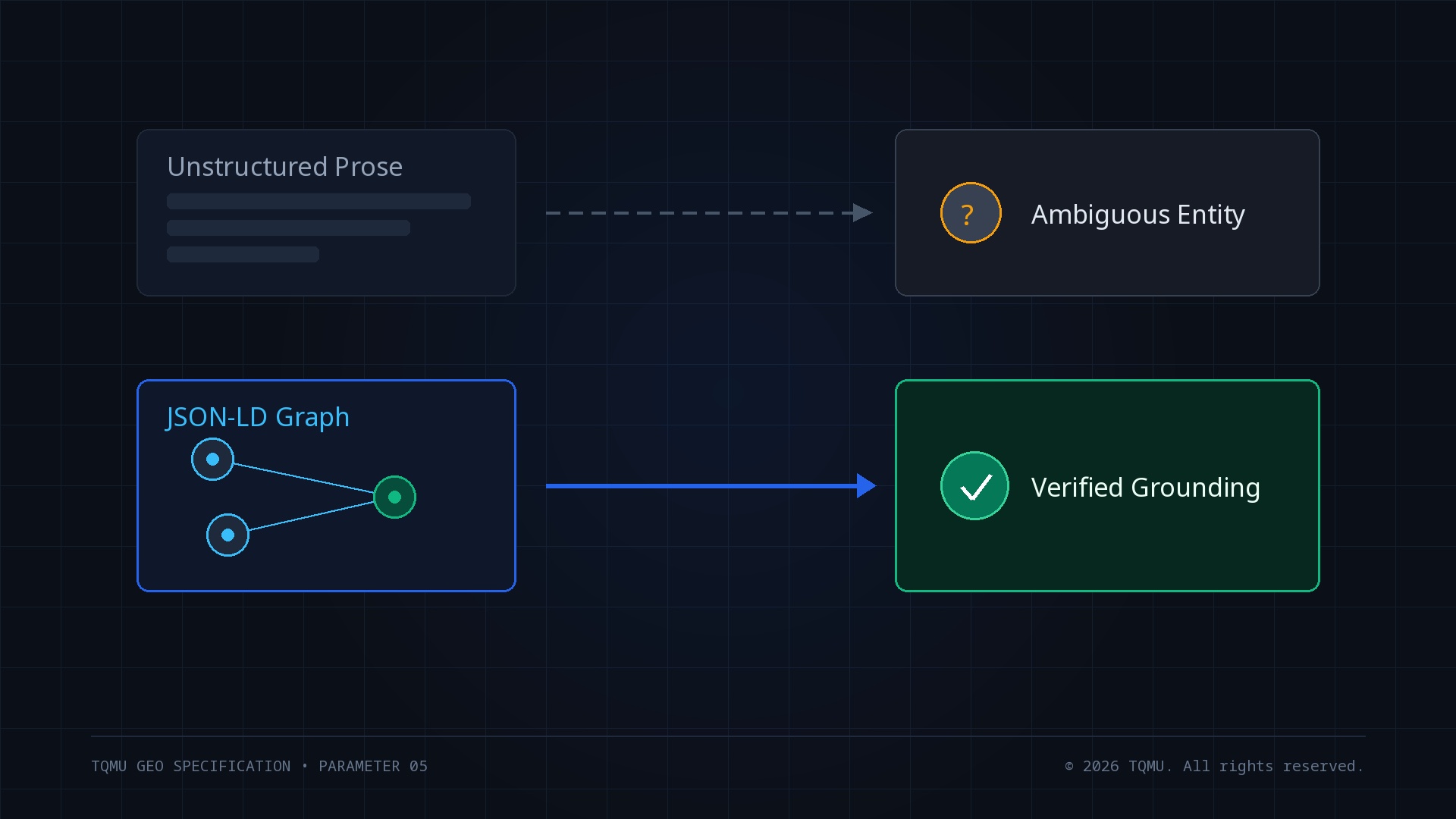
Schema.org JSON-LD Architecture: Building Machine-Readable Knowledge for Generative Search
A technical engineering guide to building disambiguated, machine-readable JSON-LD entity graphs for AI retrieval engines like ChatGPT, Perplexity, and Gemini.
Nov 14, 2026 · 12 min read
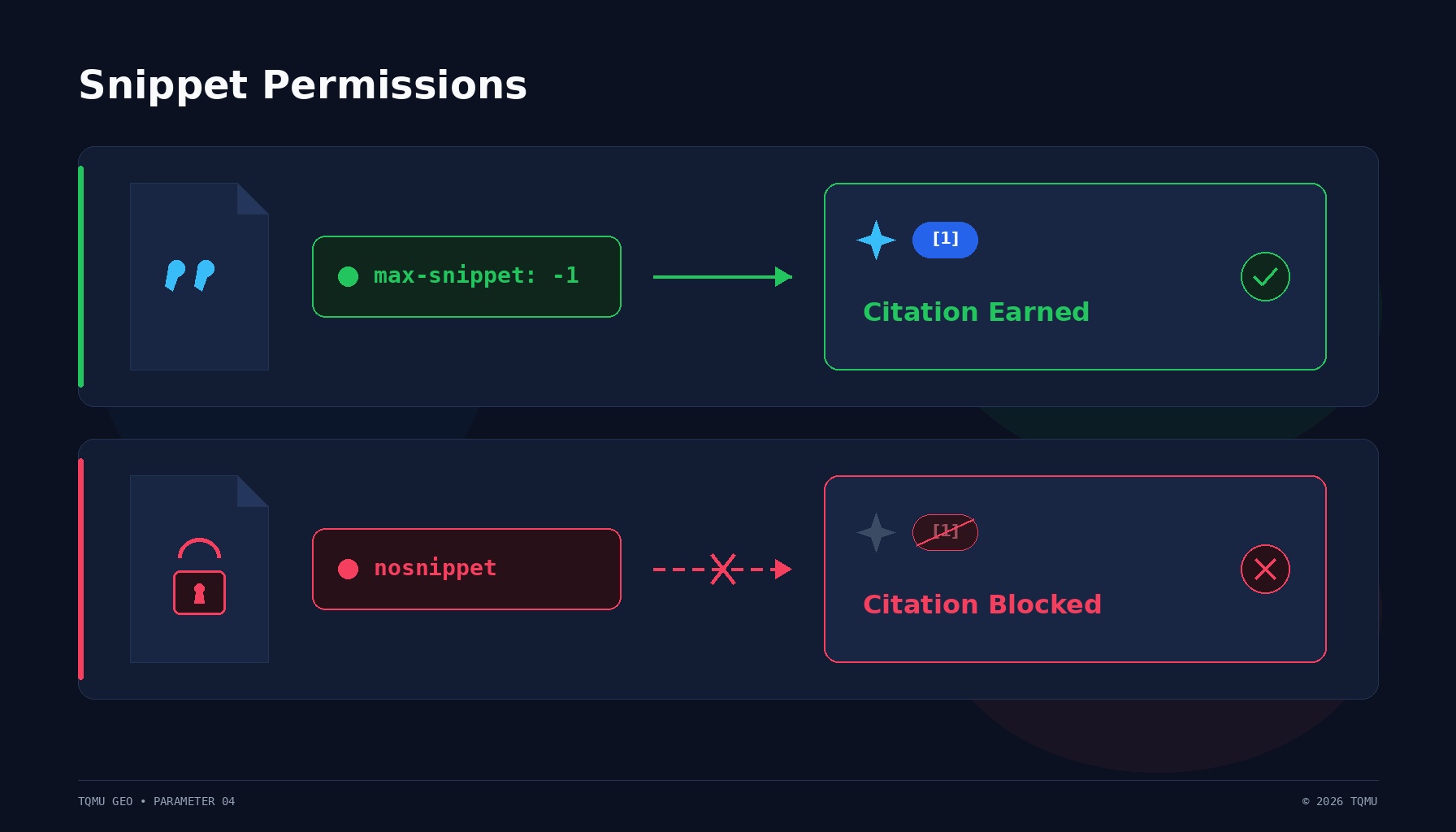
Snippet Permissions for Generative Engines: Managing nosnippet, max-snippet, and data-nosnippet
Restrictive snippet rules can stop AI search engines from quoting pages that are still indexed. How nosnippet, max-snippet and data-nosnippet work, how conflicts resolve, and how to audit them.
Nov 11, 2026 · 9 min read