Schema.org JSON-LD Architecture: Building Machine-Readable Knowledge for Generative Search
A technical engineering guide to building disambiguated, machine-readable JSON-LD entity graphs for AI retrieval engines like ChatGPT, Perplexity, and Gemini.
By J. Pannu · · 12 min read
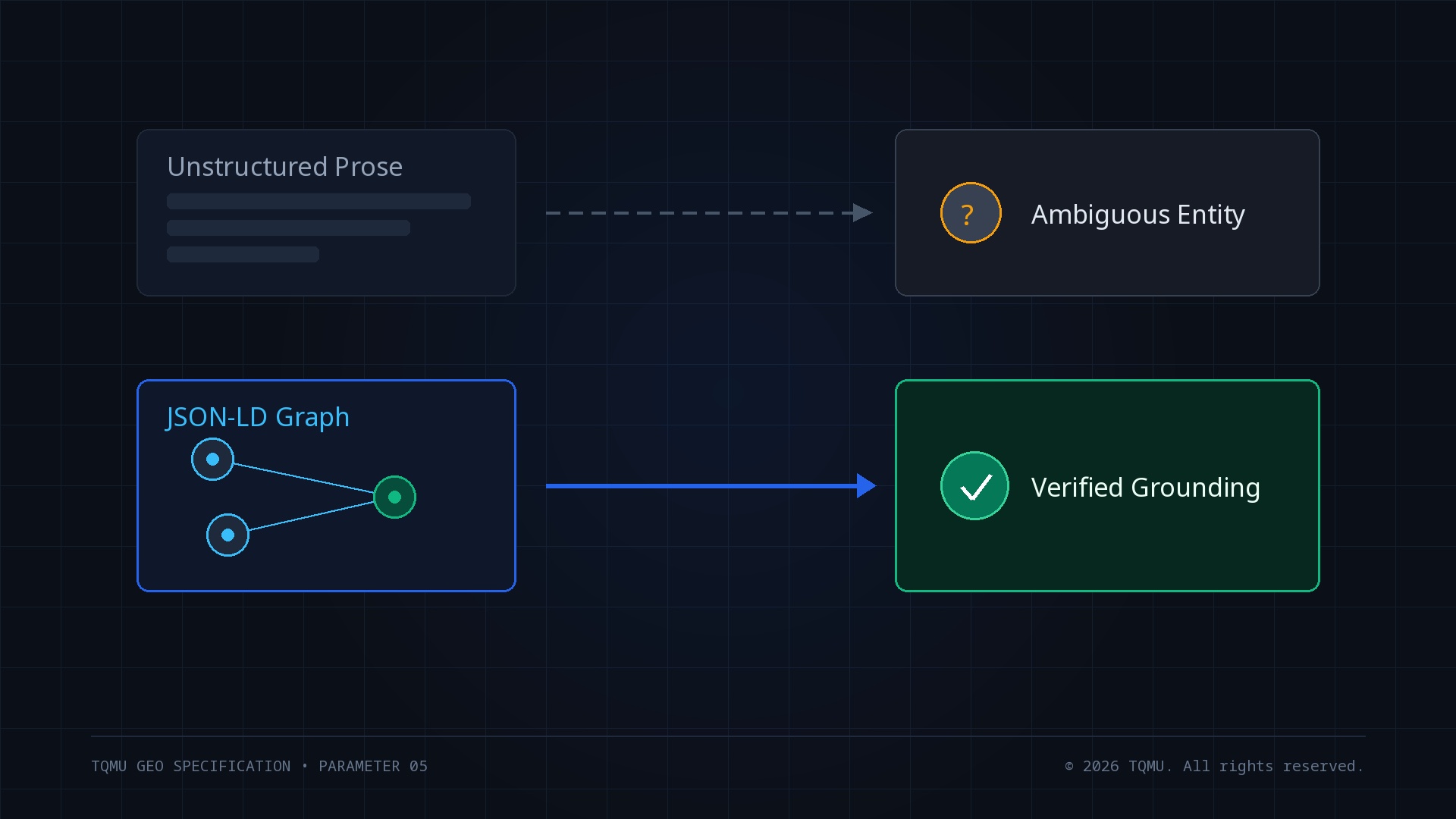
Large language models are probabilistic text predictors. When an AI search engine—such as OpenAI's SearchGPT pipeline, Perplexity's Sonar retrieval architecture, Google's Gemini-driven AI Overviews, or Anthropic's Claude-powered assistants—retrieves an HTML document, its parsing engine must extract factual assertions from natural language. In unstructured prose, entities are ambiguous: a word such as "Apple" could signify a piece of fruit, an international technology corporation, or a record label. A string like "Jaguar" could denote an animal, an automobile brand, an operating system release, or a professional sports franchise.
To bypass this probabilistic fog, generative engines rely heavily on machine-readable semantic data embedded directly within the Document Object Model. As Tim Berners-Lee, James Hendler, and Ora Lassila famously articulated in their foundational 2001 Scientific American treatise on the Semantic Web:
"The Semantic Web is not a separate Web but an extension of the current one, in which information is given well-defined meaning, better enabling computers and people to work in cooperation."
In generative engine optimization (GEO), Schema.org expressed through JavaScript Object Notation for Linked Data (JSON-LD) is the primary vehicle for providing this "well-defined meaning." While traditional search engines historically utilized structured data to illuminate SERP rich snippets (such as star ratings or recipe cook times), generative retrieval engines use JSON-LD as an authoritative, low-entropy factual substrate. It directly feeds the knowledge graph extraction pipelines that ground retrieval-augmented generation (RAG).
This technical guide details the architectural requirements for engineering production-grade JSON-LD graphs that eliminate entity ambiguity, establish explicit node relationships, and maximize authoritative citations across tier-1 generative answer engines.
1. The Semantic Gap in LLM Retrieval
When a search bot reads raw HTML prose, it executes natural language processing (NLP) and entity extraction pipelines (such as Named Entity Recognition and Relation Extraction). This introduces three critical points of failure:
- Token Ambiguity and Polysemy: Natural language relies on human contextual inference. If a page states, "We closed our Series B round led by Sequoia," an NLP pipeline must infer whether "Sequoia" refers to the venture capital firm Sequoia Capital or the redwood tree species Sequoiadendron giganteum.
- Context Fragmentation across DOM Trees: In complex responsive layouts, associated facts are frequently split across disparate DOM nodes—an author's name might sit in a header
<span>, their institutional affiliation in a sidebar<aside>, and their verified credentials in a footer<div>. An extraction pipeline chunking HTML by character length or token windows often separates the entity from its predicates. - Extraction Uncertainty Penalties: RAG pipelines assign confidence scores to extracted propositions before feeding them into an LLM's prompt context. If the relation between an author, an organization, and a factual claim has a low extraction confidence score, the retrieval engine actively discards the chunk to prevent hallucinated citations.
JSON-LD closes this gap by providing an explicit, deterministic schema that sits alongside the presentation layer. By structuring claims as unambiguous semantic triples—Subject, Predicate, and Object—publishers provide generative parsers with pre-computed facts that can be ingested directly into vector databases and knowledge graphs without probabilistic extraction loss.
2. W3C JSON-LD 1.1 Specification and the Entity Graph
JSON-LD was standardized by the World Wide Web Consortium (W3C) as a syntax to serialize Linked Data using standard JSON. As defined in the W3C JSON-LD 1.1 Recommendation:
"JSON-LD is a concrete syntax to serialize Linked Data. It is designed to be usable directly as standard JSON, with no out-of-band information, while providing a way to disambiguate keys and values using IRIs."
To build schemas that AI crawlers can parse without error, engineers must master the four foundational JSON-LD keywords:
@context
The @context defines the vocabulary mapping. Pointing @context to "https://schema.org" instructs the parser that all unqualified keys within the object correspond to formal semantic definitions managed by the Schema.org community.
{
  "@context": "https://schema.org"
}
@type
The @type specifies the formal ontological class of the entity being described. Schema.org defines a hierarchical type inheritance structure: an Article is a subtype of CreativeWork, which in turn inherits from Thing. Generative engines prioritize specific subtypes over generic ones because more specific classes enforce tighter semantic constraints.
@id (The Internationalized Resource Identifier)
The @id keyword is the single most critical—and most frequently omitted—property in enterprise structured data. In linked data architecture, an @id provides a globally unique, persistent identifier for a specific entity node. Without @id, an entity is an anonymous blank node that cannot be cross-referenced or connected across different parts of the website or external knowledge bases.
A robust @id convention appends an explicit URL fragment or URI scheme to the canonical URL:
- Organization node:
https://www.example.com/#organization - WebSite node:
https://www.example.com/#website - WebPage node:
https://www.example.com/blog/article-slug#webpage - Primary entity node:
https://www.example.com/blog/article-slug#article - Author node:
https://www.example.com/authors/jane-doe#person
@graph
Rather than embedding multiple disconnected <script type="application/ld+json"> tags across an HTML document, production GEO architecture consolidates all entities into a single unified @graph array. The @graph array represents a connected knowledge graph where nodes point to each other via their @id values.
3. Disambiguation: Grounding Entities in Global Authority
Stating that your organization is named "Acme Logistics" is insufficient for a generative engine if hundreds of registered entities share identical or similar names. To achieve definitive entity grounding, your structured data must link internal nodes to external, globally verified entity registries using the sameAs property.
In their landmark paper "Schema.org: Evolution of Structured Data on the Web" (Communications of the ACM, 2016), R.V. Guha, Dan Brickley, and Steve Macbeth emphasize that structured data acts as the bridge connecting private web content to global linked data ecosystems:
"Schema.org is a collaborative, community activity with a mission to create, maintain, and promote schemas for structured data on the Internet, on Web pages, in email messages, and beyond... It provides a shared vocabulary that enables webmasters to describe their sites in ways that major search providers can understand."
Authoritative Disambiguation Registries
When populating sameAs arrays for organizations and authors, prioritize immutable, machine-curated authority registries over casual social profiles:
- Wikidata (Q-IDs): Wikidata is the primary structured knowledge base queried by Gemini, Perplexity, and ChatGPT. If your company or author has a Wikidata entity (e.g.,
https://www.wikidata.org/wiki/Q11487), it must be declared. - Wikipedia: The human-readable counterpart to Wikidata, widely used by LLMs during pre-training and RAG grounding.
- CRUNCHBASE & LinkedIn: For commercial organizations and executive leadership.
- ORCID (Open Researcher and Contributor ID): For academic researchers, medical practitioners, and technical authors.
- VIAF (Virtual International Authority File) & ISNI: For published authors and established domain experts.
Disambiguation in Practice
{
  "@type": "Organization",
  "@id": "https://www.example.com/#organization",
  "name": "TQMU Technologies",
  "legalName": "TQMU Global Inc.",
  "url": "https://www.example.com",
  "sameAs": [
    "https://www.wikidata.org/wiki/Q12345678",
    "https://en.wikipedia.org/wiki/TQMU_Technologies",
    "https://www.crunchbase.com/organization/tqmu",
    "https://www.linkedin.com/company/tqmu"
  ]
}
When a generative engine synthesizes an answer regarding your industry, it cross-references the retrieved document's declared entity @id with its pre-trained knowledge base. The sameAs links confirm that the organization publishing the content is the identical entity registered in Wikipedia and Wikidata, elevating the source's factual authority and citation probability.
4. The Connected @graph Architecture: Top-Level Production Blueprint
A common anti-pattern in web development is pasting disconnected JSON-LD snippets: one for the company in the layout header, one for the article in the page template, and one for breadcrumbs in a navigation widget. This forces the crawler to guess how these disparate nodes interrelate.
The professional standard is a single, interconnected JSON-LD @graph embedded within the <head> of the HTML response. This graph links:
- The Publishing Organization (
Organization) - The WebSite container (
WebSite) - The Specific WebPage (
WebPageorItemPage) - The Primary Document/Entity (
Article,TechArticle,Product, orService) - The Author (
Person) with verified credentials - The Breadcrumb Hierarchy (
BreadcrumbList)
Complete Architectural Blueprint
Below is the production-ready JSON-LD schema for an authoritative technical guide:
<script type="application/ld+json">
{
  "@context": "https://schema.org",
  "@graph": [
    {
      "@type": "Organization",
      "@id": "https://www.example.com/#organization",
      "name": "TQMU",
      "url": "https://www.example.com",
      "logo": {
        "@type": "ImageObject",
        "@id": "https://www.example.com/#logo",
        "url": "https://www.example.com/assets/tqmu-logo.png",
        "contentUrl": "https://www.example.com/assets/tqmu-logo.png",
        "caption": "TQMU Logo"
      },
      "sameAs": [
        "https://www.wikidata.org/wiki/Q99999999",
        "https://www.linkedin.com/company/tqmu"
      ]
    },
    {
      "@type": "WebSite",
      "@id": "https://www.example.com/#website",
      "url": "https://www.example.com",
      "name": "TQMU",
      "description": "Generative Engine Optimization Diagnostics and Knowledge Graph Standards",
      "publisher": {
        "@id": "https://www.example.com/#organization"
      }
    },
    {
      "@type": "Person",
      "@id": "https://www.example.com/authors/dr-elena-rostova#person",
      "name": "Dr. Elena Rostova",
      "jobTitle": "Principal Knowledge Graph Architect",
      "worksFor": {
        "@id": "https://www.example.com/#organization"
      },
      "sameAs": [
        "https://orcid.org/0000-0002-1825-0097",
        "https://www.wikidata.org/wiki/Q88888888"
      ]
    },
    {
      "@type": "WebPage",
      "@id": "https://www.example.com/blog/schema-org-jsonld-architecture#webpage",
      "url": "https://www.example.com/blog/schema-org-jsonld-architecture",
      "name": "Schema.org JSON-LD Architecture: Building Machine-Readable Knowledge for Generative Search",
      "isPartOf": {
        "@id": "https://www.example.com/#website"
      },
      "breadcrumb": {
        "@id": "https://www.example.com/blog/schema-org-jsonld-architecture#breadcrumb"
      }
    },
    {
      "@type": "TechArticle",
      "@id": "https://www.example.com/blog/schema-org-jsonld-architecture#article",
      "isPartOf": {
        "@id": "https://www.example.com/blog/schema-org-jsonld-architecture#webpage"
      },
      "headline": "Schema.org JSON-LD Architecture: Building Machine-Readable Knowledge for Generative Search",
      "description": "A technical engineering guide to building disambiguated, machine-readable JSON-LD entity graphs for AI retrieval engines.",
      "datePublished": "2026-11-12T08:00:00+00:00",
      "dateModified": "2026-11-12T08:00:00+00:00",
      "mainEntityOfPage": {
        "@id": "https://www.example.com/blog/schema-org-jsonld-architecture#webpage"
      },
      "author": {
        "@id": "https://www.example.com/authors/dr-elena-rostova#person"
      },
      "publisher": {
        "@id": "https://www.example.com/#organization"
      },
      "inLanguage": "en-US",
      "keywords": [
        "Schema.org",
        "JSON-LD",
        "Generative Engine Optimization",
        "Entity Graph",
        "Linked Data"
      ]
    },
    {
      "@type": "BreadcrumbList",
      "@id": "https://www.example.com/blog/schema-org-jsonld-architecture#breadcrumb",
      "itemListElement": [
        {
          "@type": "ListItem",
          "position": 1,
          "name": "Home",
          "item": "https://www.example.com"
        },
        {
          "@type": "ListItem",
          "position": 2,
          "name": "Technical Blog",
          "item": "https://www.example.com/blog"
        },
        {
          "@type": "ListItem",
          "position": 3,
          "name": "Schema.org JSON-LD Architecture",
          "item": "https://www.example.com/blog/schema-org-jsonld-architecture"
        }
      ]
    }
  ]
}
</script>
In this schema, there are zero disconnected nodes. The TechArticle cites its author by referencing @id: "...#person". The Person node asserts that their employer is @id: "...#organization". The WebPage is part of @id: "...#website", which in turn is published by @id: "...#organization". An AI engine can ingest this single block and build a complete, verified semantic subgraph in a single parse cycle.
5. Critical Implementation Pitfalls That Break AI Ingestion
While many websites claim to have structured data, technical audits of enterprise websites frequently uncover structural defects that diminish their utility for generative search engines.
1. The Dangling Node Error
When referencing another node via @id, that referenced entity must either be defined elsewhere within the same @graph or resolve to a crawlable URI that exposes its definition. If an Article declares "author": {"@id": "https://www.example.com/authors/jane-doe#person"} but the #person node is not defined in the graph and the author URL returns a 404 or lacks JSON-LD, the reference dangles and the author relationship is discarded.
2. Client-Side Hydration Delay
As established in our technical guide on Server-Rendered Content, generative crawlers frequently bypass JavaScript execution. If your web application (e.g., a Single Page Application built on React, Vue, or Angular) injects its <script type="application/ld+json"> tag via a client-side hook (such as useEffect or react-helmet) after DOM hydration, bots retrieving the raw HTTP response will see zero structured data. JSON-LD must be rendered into the server response stream at time of delivery.
3. Entity Property Type Coercion
Schema.org defines strict property types. For example:
datePublishedanddateModifiedmust strictly adhere to ISO 8601 format (YYYY-MM-DDorYYYY-MM-DDTHH:MM:SSZ). Supplying a colloquial string like"November 12, 2026"causes schema parsers to reject the temporal entity.- The
publisherandauthorproperties expect aThing(such asOrganizationorPerson), not a raw string. Writing"author": "John Doe"is invalid Schema.org; it must be expressed as"author": {"@type": "Person", "name": "John Doe"}.
4. Text-Content Desynchronization
Search engine guidelines mandate that structured data must accurately represent the visible content on the webpage. If your JSON-LD declares an article price of $49 or an author named "Dr. Alice Smith", but the visible HTML displays $99 or attributes the article to "Staff Reporter", semantic validation filters trigger a trust penalty. Generative engines aggressively cross-check structured claims against the visible body text before admitting facts into their context window.
6. Diagnostic and Verification Workflows
To audit whether your JSON-LD architecture is syntactically sound and structurally intact for AI parsers, maintain an automated CI/CD verification pipeline.
Step 1: Extract Raw JSON-LD via cURL and JQ
To inspect the exact payload delivered to automated bots without browser distortion, execute:
curl -s -L -A "OAI-SearchBot/1.0" "https://www.example.com/blog/article-slug" \
  | grep -Pzo '(?s)<script type="application\/ld\+json">.*?<\/script>' \
  | sed 's/<script type="application\/ld+json">//g; s/<\/script>//g' \
  | jq .
If jq outputs a formatted JSON tree without syntax errors, your JSON payload is well-formed. If it returns a parse error, your template has invalid escaping, unescaped quotes, or trailing commas.
Step 2: Validate Semantic Schema Compliance
Submit the extracted JSON-LD to official semantic validation engines:
- Schema.org Official Validator (
validator.schema.org): Verifies syntax against the pure Schema.org ontology. - Google Rich Results Test (
search.google.com/test/rich-results): Checks for adherence to commercial search engine extraction rules.
Step 3: Verify Graph Connectedness
Ensure that all @id references within your @graph array resolve internally:
# Check that all referenced @id targets exist as node definitions
jq '.["@graph"] | {defined: [.[]["@id"]], referenced: [.. | objects | select(has("@id")) | .["@id"]]} | .referenced - .defined' schema.json
If the resulting array is empty, all internal references are cleanly resolved.
7. The TQMU GEO Rule Definition: Parameter 05
In the TQMU Generative Engine Optimization diagnostic specification, Parameter 05 governs Schema.org JSON-LD compliance. The audit rule enforces:
- Pass Condition (Score 5/5): The page contains well-formed, top-level JSON-LD structured data describing the main entity (Article, Product, Service, Organization, or SoftwareApplication) with explicit
@idattributes and connected nodes. - Partial Condition (Score 2–4/5): JSON-LD blocks are detected but describe only disconnected fragments (e.g., an isolated BreadcrumbList without parent Organization or WebSite linkage).
- Fail Condition (Score 0/5): No JSON-LD structured data is present in the raw server response, leaving generative crawlers entirely dependent on probabilistic NLP extraction.
Summary Checklist for Production JSON-LD
- Format: Express structured data exclusively via JSON-LD (
<script type="application/ld+json">), avoiding legacy Microdata or RDFa attributes embedded in HTML tags. - Architecture: Use a single, unified
@graphblock linking Organization, WebSite, WebPage, Primary Entity, and Author. - Identity: Assign an explicit
@idURI to every major entity node. - Disambiguation: Provide verified
sameAsarrays referencing Wikidata, Wikipedia, ORCID, or official registries. - Delivery: Ensure the complete JSON-LD block is server-rendered in the initial HTML response.
- Integrity: Format dates in ISO 8601, nest complex entities rather than using raw strings, and maintain 100% parity with visible page text.
By implementing an interconnected, disambiguated JSON-LD entity graph, you transition your website from an ambiguous block of text into an authoritative knowledge node that generative search engines can parse, trust, and cite with precision.
References and Standards
- W3C JSON-LD 1.1 Recommendation: W3C Recommendation 16 July 2020. JSON-LD 1.1: A JSON-based Serialization for Linked Data. Syntax, Data Model, and Processing Algorithms. https://www.w3.org/TR/json-ld11/
- Berners-Lee, T., Hendler, J., & Lassila, O. (2001): "The Semantic Web." Scientific American, 284(5), 34–43. Foundational paper on machine-readable semantic structures.
- Guha, R. V., Brickley, D., & Macbeth, S. (2016): "Schema.org: Evolution of Structured Data on the Web." Communications of the ACM, 59(2), 44–51. https://doi.org/10.1145/2844544
- Schema.org Community Group: Schema.org Vocabulary Documentation & Specification. Managed by W3C Community Group. https://schema.org
- Google Search Central: Understand How Structured Data Works & General Structured Data Guidelines. https://developers.google.com/search/docs/appearance/structured-data/intro-structured-data
- IETF RFC 3986: Uniform Resource Identifier (URI): Generic Syntax. Internet Engineering Task Force. https://www.rfc-editor.org/rfc/rfc3986
Frequently asked questions
Why is JSON-LD preferred over Microdata or RDFa for generative search?
- JSON-LD is decoupled from the HTML presentation markup. While Microdata and RDFa require scattering attributes across HTML tags (making maintenance fragile and error-prone), JSON-LD is consolidated into a single, clean <script> block. Generative crawlers can extract and parse this single JSON payload with significantly lower computational overhead and zero risk of DOM parsing failures.
Can I have multiple <script type="application/ld+json"> tags on a single page?
- Yes, search engines can technically parse multiple JSON-LD tags. However, doing so scatters your entity definitions and often results in disconnected nodes. Consolidating all entities into a single <script> block using an @graph array is the architectural best practice because it explicitly defines how the organization, website, author, and article relate to one another.
How does JSON-LD affect AI citations in Perplexity or ChatGPT?
- When a generative engine processes a query, its retrieval engine evaluates candidate web pages. If a page provides explicit JSON-LD, the engine can instantly verify key factual predicates (such as the author's credentials, publication date, and organizational backing) without ambiguity. High-confidence factual grounding increases the probability that the engine's RAG pipeline selects your passage for direct synthesis and citation.
What is the purpose of the @id attribute in Schema.org?
- The @id attribute assigns a globally unique, persistent identifier (Uniform Resource Identifier) to an entity node. It transforms an anonymous JSON object into an addressable entity. This allows different nodes within the same page—or across different pages of your website—to reference that exact entity without duplicating its entire property tree.
Should I mark up content that is hidden from human visitors?
- No. Both Google guidelines and generative engine integrity checks explicitly require that structured data reflect content that is directly accessible and visible to human readers. Marking up hidden text, fictitious reviews, or unverified claims triggers algorithmic spam filters and will lead to your structured data being disqualified by retrieval engines.
Does JSON-LD replace the need for clear on-page natural language?
- No. JSON-LD provides the semantic skeleton, while natural language delivers the substantive passage. An AI engine quotes and synthesizes natural language prose in its final generated answer; it uses JSON-LD to verify that the prose is authoritative, current, and attributed to a verified source. Both layers must operate in harmony.
What are the most authoritative URLs to use in sameAs for an organization?
- The most impactful sameAs targets for LLM grounding are authoritative knowledge registries: Wikidata (e.g., https://www.wikidata.org/wiki/Q...), Wikipedia, Crunchbase, official government corporate registries, and established industry directories. Social media profiles (such as LinkedIn or X) are acceptable secondary signals but carry less ontological weight than Wikidata.
About the author
J. Pannu · Founder
Full-stack online marketing professional. Simultaneously placed multiple websites in the top, most visited sites in the world.
Keep reading
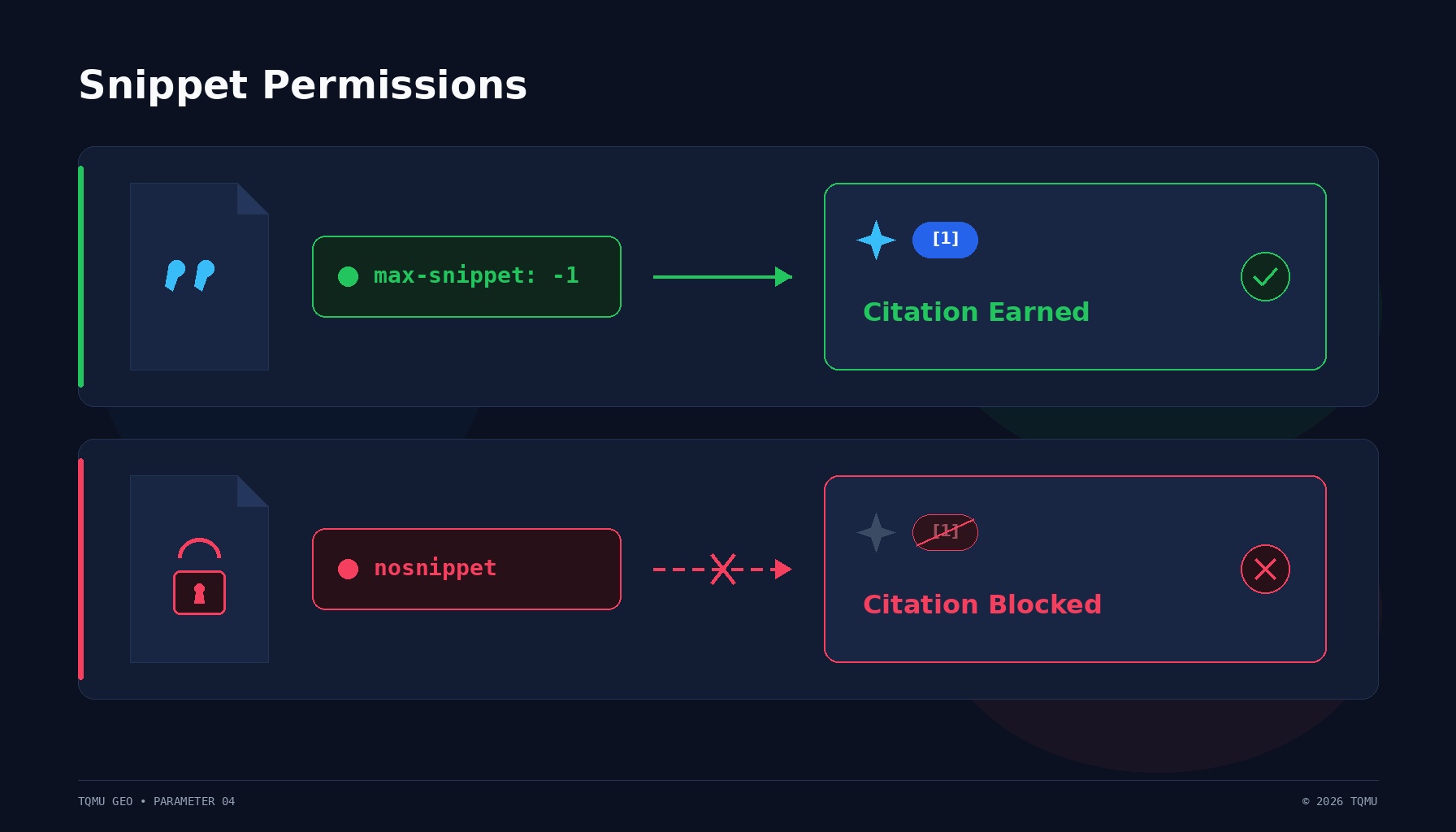
Snippet Permissions for Generative Engines: Managing nosnippet, max-snippet, and data-nosnippet
Restrictive snippet rules can stop AI search engines from quoting pages that are still indexed. How nosnippet, max-snippet and data-nosnippet work, how conflicts resolve, and how to audit them.
Nov 11, 2026 · 9 min read
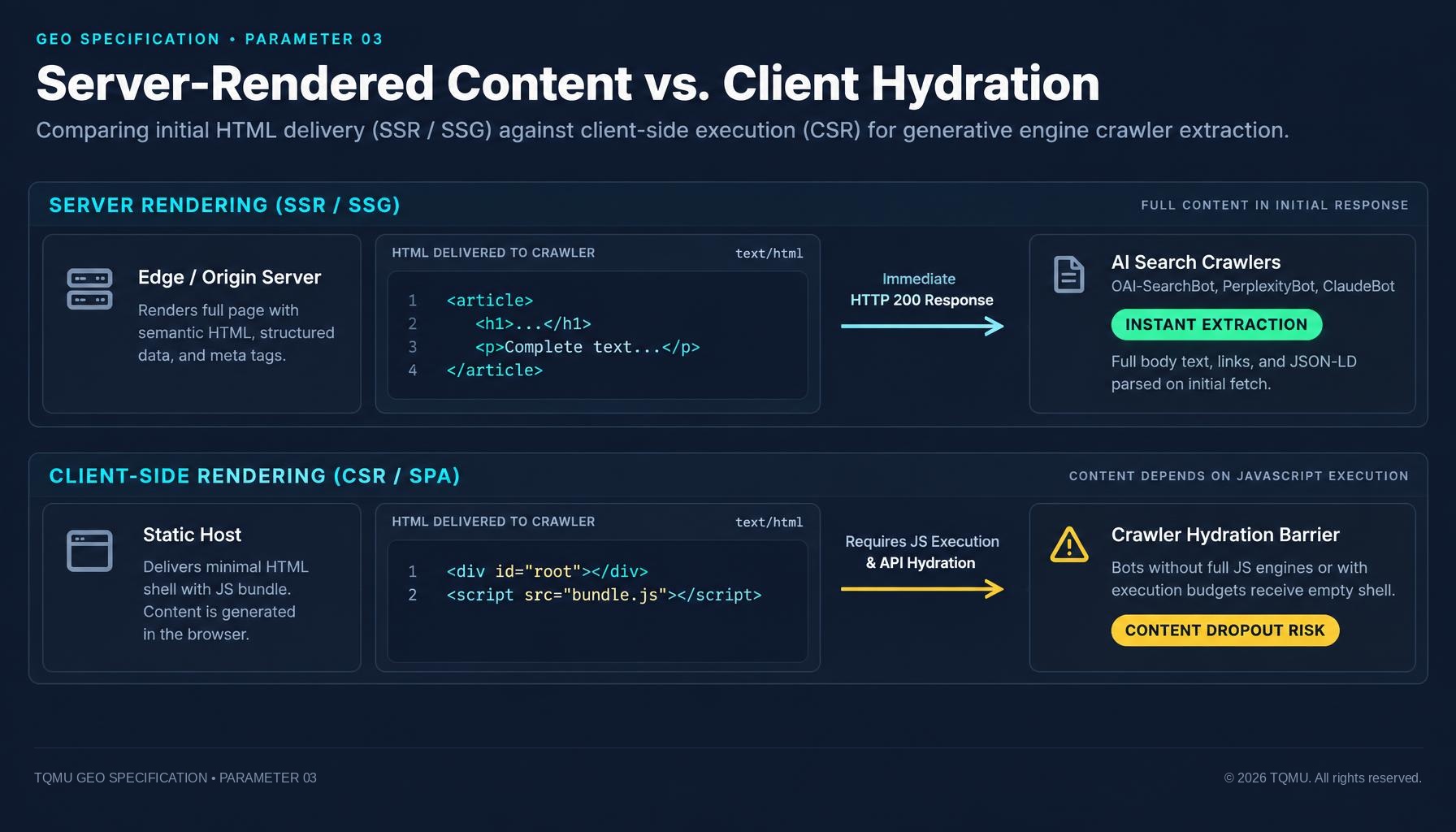
Server-rendered content vs. client hydration: why AI bots can miss JavaScript sites
If your main content appears only after JavaScript runs, some crawlers may see an empty page shell. How SSR, static generation and hydration affect what search and AI crawlers can read, and how to test what your server sends.
Nov 11, 2026 · 10 min read
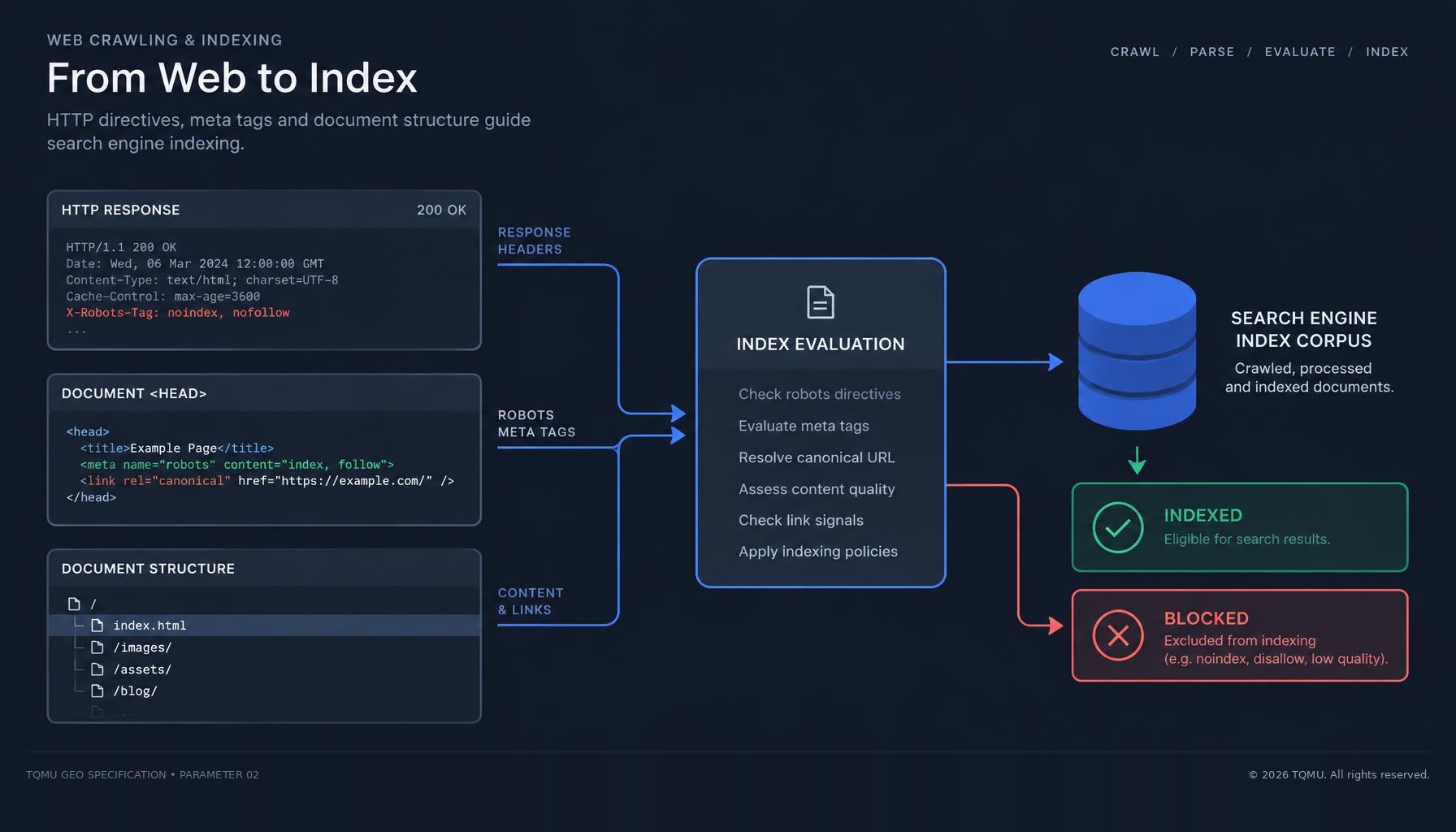
Indexability Signals for Generative Engines: Eliminating Accidental noindex and Header Dropouts
A page can load normally for visitors while HTTP headers or meta tags tell search crawlers not to index it. How to audit noindex directives, resolve conflicts with robots.txt, and ensure AI engines can index and cite your public pages.
Nov 11, 2026 · 9 min read