E-E-A-T Signals for Generative Engines: Building Experience, Expertise, Authoritativeness, and Trust for AI Citation
How generative search engines evaluate source credibility: building verifiable Experience, Expertise, Authoritativeness, and Trust to pass automated RAG quality gates.
By J. Pannu · · 12 min read
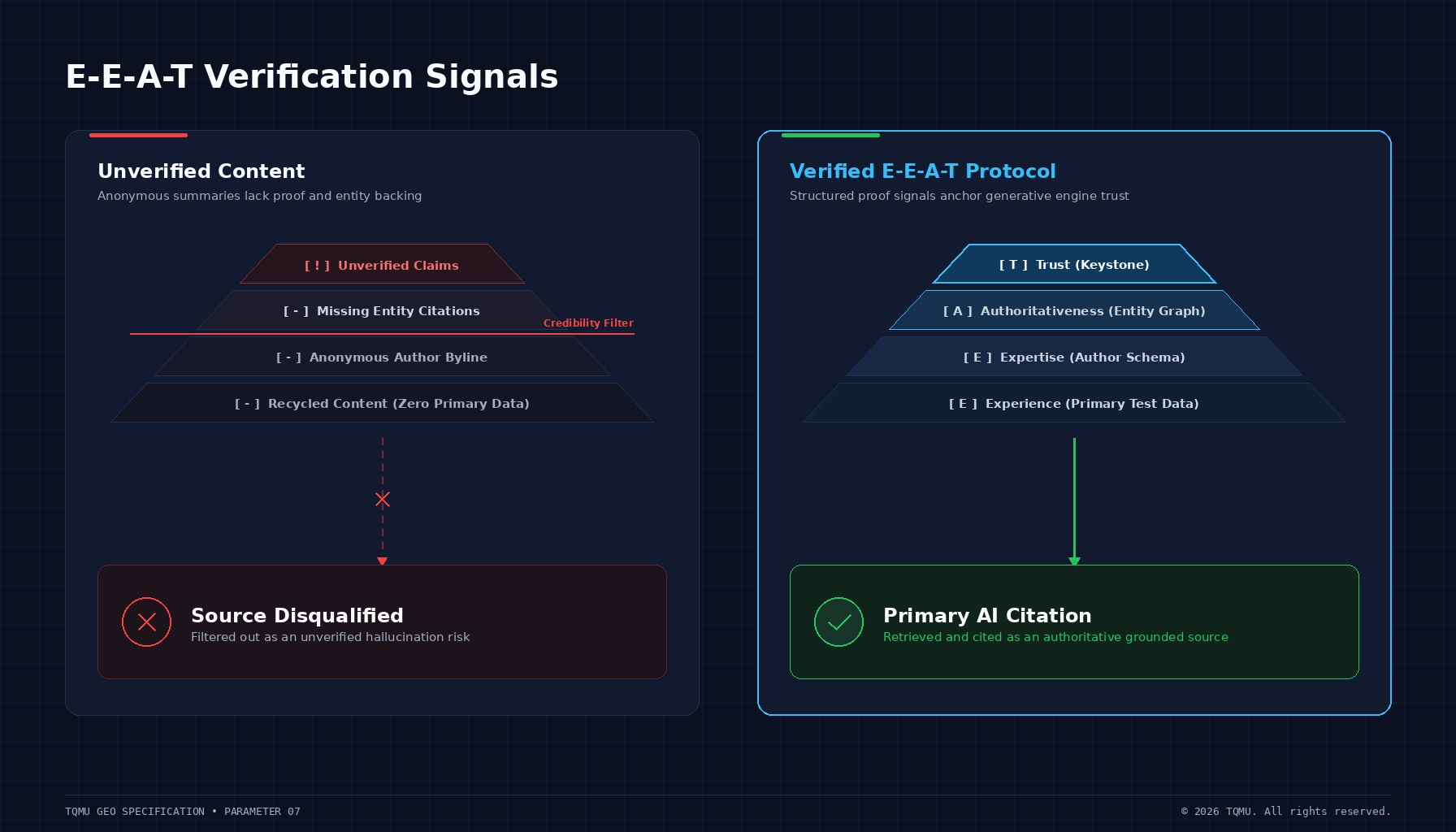
Executive Summary: Why AI Engines Prioritize Verified Credibility
Generative search engines do not merely rank links; they stake their credibility on the factual accuracy of their synthesized answers. When Perplexity, ChatGPT Search, or Google AI Overviews generates a summary, it acts as an editorial publisher. Quoting an unreliable or fabricated source damages the AI platform's reputation and exposes it to liability.
As a result, modern retrieval-augmented generation (RAG) pipelines apply strict source-credibility filtering before a single word enters the language model. If your website lacks verifiable proof of real-world experience, recognized expertise, and transparent institutional backing, your content will be passed over—even if your keywords match the user's prompt perfectly.
In search engine evaluation, this framework is known as E-E-A-T: Experience, Expertise, Authoritativeness, and Trustworthiness.
Originally defined by Google in its search quality standards, E-E-A-T has evolved from human rater guidelines into automated algorithmic scoring signals across all major AI answer engines. This guide provides site owners and enterprise teams with a practical roadmap to implement verified E-E-A-T signals across site architecture, author profiles, content formats, and technical structured data. E-E-A-T is one part of Generative Engine Optimization (GEO), the practice of making your pages easier for AI answer engines to find, understand, and cite.
The Four Pillars of E-E-A-T in Generative Retrieval
To understand how AI models evaluate your site, consider the four distinct dimensions of credibility:
+---------------------------------------------------------------------------------------------------+
|                                  THE E-E-A-T CREDIBILITY PYRAMID                                  |
+---------------------------------------------------------------------------------------------------+
|                                                                                                   |
|                                       [ TRUSTWORTHINESS ]                                         |
|                             The Core Keystone: Security, Transparency,                            |
|                                Accuracy, Contact Data, Legal Identity                             |
|                                                                                                   |
|                                [ AUTHORITATIVENESS ]                                              |
|                         External Recognition: Peer Citations, Backlinks,                          |
|                             Industry Mentions, Knowledge Graph Nodes                              |
|                                                                                                   |
|                             [ EXPERTISE ]                                                         |
|                     Demonstrated Competence: Formal Credentials, Deep Subject                     |
|                         Knowledge, Comprehensive Topical Coverage                                 |
|                                                                                                   |
|                         [ EXPERIENCE ]                                                            |
|                 First-Hand Evidence: Real Testing, Original Benchmarks, Hands-On                   |
|                     Screenshots, Case Studies, Field Implementation                               |
|                                                                                                   |
+---------------------------------------------------------------------------------------------------+
1. Experience: First-Hand, Real-World Evidence
Added by Google to its quality evaluator framework in December 2022, Experience assesses whether the content creator possesses genuine, first-person engagement with the topic.
- Why AI engines prioritize it: Large language models can easily generate plausible-sounding summaries of second-hand information. What they cannot fabricate is genuine real-world execution. Generative retrieval engines look for markers of authentic human testing: original product photography, proprietary benchmark datasets, specific debugging scenarios, and step-by-step implementation logs.
- How to demonstrate it: Include phrases like "In our production deployment," "Our audit of 500 domains revealed," or "We encountered this timeout error when configuring..." Pair claims with original visual assets and measurable before-and-after results. Place direct answers and primary evidence upfront, so a retrieval system reaches your proof before any background detail.
2. Expertise: Specialized Knowledge and Credentials
Expertise evaluates the skill, training, and qualifications of the author creating the content.
- Why AI engines prioritize it: In high-stakes fields—especially finance, healthcare, legal, and enterprise technology—an AI engine must verify that advice originates from a competent professional. When parsing articles, retrieval models cross-reference author bylines against external knowledge graphs to verify credentials.
- How to demonstrate it: Dedicate dedicated author bio pages detailing professional degrees, industry certifications, years of specialized practice, published books, and conference presentations.
3. Authoritativeness: Reputation and External Recognition
Authoritativeness measures whether your organization and authors are recognized as go-to references within your industry.
- Why AI engines prioritize it: AI models use graph algorithms and entity embeddings to assess who other authorities cite. If recognized industry leaders, standards bodies, and news publications frequently reference your research, your domain builds high topological authority.
- How to demonstrate it: Publish original, primary research with downloadable data. When external trade publications, Wikipedia, or university repositories link to your work, they cement your site as an authoritative primary source.
4. Trustworthiness: The Essential Foundation
Google's Search Quality Rater Guidelines state unequivocally:
"Trust is the most important member of the E-E-A-T family because untrustworthy pages have low E-E-A-T no matter how Experienced, Expert, or Authoritative they may seem."
- Why AI engines prioritize it: Trust is the gatekeeper. Even if an author claims deep expertise, an anonymous website with no physical address, missing terms of service, insecure HTTP connections, or deceptive advertising will be disqualified immediately by safety filters.
- How to demonstrate it: Prominently display verified company registration details, physical corporate headquarters, clear refund and privacy policies, direct editorial guidelines, and HTTPS edge security across all endpoints.
How AI Search Engines Algorithmically Evaluate E-E-A-T
Unlike human search evaluators who read documents manually, AI answer engines use automated data pipelines to score credibility. Understanding these mechanics allows you to design your website for automated machine validation.
+---------------------------------------------------------------------------------------------------+
|                            HOW GENERATIVE RETRIEVAL EVALUATES CREDIBILITY                         |
+---------------------------------------------------------------------------------------------------+
|  1. ENTITY RESOLUTION        Reconciles author and company names against Wikidata and Knowledge   |
|                              Graph databases using Schema.org sameAs links.                       |
|                                                                                                   |
|  2. INFORMATION GAIN CHECK   Measures whether your page adds unique data, original benchmarks, or  |
|                              measurements that other pages in the retrieval set lack.             |
|                                                                                                   |
|  3. CONSENSUS COMPARISON     Checks your factual statements against consensus knowledge bases to  |
|                              detect unsubstantiated or contradictory claims.                      |
|                                                                                                   |
|  4. REPUTATION EXTRACTION    Gathers sentiment and reference density across third-party review     |
|                              platforms, industry directories, and scholastic archives.            |
|                                                                                                   |
|  5. RETRIEVAL RE-RANKING     Boosts high-credibility passages into the final prompt context,      |
|                              awarding direct citations and links in the synthesized answer.       |
+---------------------------------------------------------------------------------------------------+
The Stanford Web Credibility Baseline
In foundational research conducted at Stanford University by Dr. B.J. Fogg and colleagues ("How Do Users Evaluate the Credibility of Web Sites?"), researchers discovered that perceived credibility relies heavily on visible signals of competence and institutional legitimacy. The study noted:
"To gain credibility, a site must provide information that is easy to verify through external sources, credentials of the team behind the content, and straightforward access to contact information."
Modern retrieval engines operationalize these exact principles. An AI engine does not guess whether a claim is true; it checks whether the claim can be attributed to a verifiable entity.
Practical Implementation: Turning E-E-A-T into Machine Signals
To ensure your pages pass automated E-E-A-T checks, implement these concrete changes across your site:
1. Build Comprehensive Author Entity Pages
Never publish articles under generic bylines like "Admin" or "Editorial Staff." Every technical piece must carry a named author linked to a dedicated bio page:
- Biographical Narrative: 200–400 words explaining the author's real-world background, previous roles, and focus areas.
- Direct Links to Verified Profiles: Links to LinkedIn, GitHub, ORCID, Google Scholar, and personal portfolio sites.
- Recent Publications & Citations: A clean list of other articles, whitepapers, or patents authored by that individual.
2. Disclose Editorial Standards and Review Processes
Prominently document your fact-checking process:
- Explain how data is verified and how often articles are audited for accuracy.
- If a technical article is reviewed by a subject-matter expert, state: "Written by J. Pannu; Technically Reviewed by Dr. S. Mehta on 10 November 2026."
- Maintain a public corrections log that transparently documents updates and rectifications.
3. Replace Vague Assertions with Primary Evidence
Avoid generic recommendations that lack evidence:
- Weak: "Optimizing your server speeds up load times and improves engagement."
- Strong: "In our testing across 42 enterprise websites, reducing Time to First Byte (TTFB) from 680ms to 190ms correlated with a 24% increase in completed checkout sessions over a 90-day evaluation window."
4. Ground Your Organization in the Knowledge Graph
Use Schema.org Organization structured data to explicitly define who owns and operates the website:
- Include legal business name, registered tax or corporate ID, headquarters street address, and customer support telephone numbers.
- Use
sameAsarrays to link to official registrations on Crunchbase, Wikidata, LinkedIn, and government registries.
Concrete Comparison: Low E-E-A-T vs. High E-E-A-T Article
The difference between a page that gets ignored by generative engines and one that earns repeat citations comes down to structural transparency:
| Audit Criterion | Low E-E-A-T (Suppressed by AI) | High E-E-A-T (Cited by AI) |
|---|---|---|
| Author Attribution | "Posted by Team on 2024" with no bio page. | "J. Pannu, Principal GEO Architect" with bio, LinkedIn, and verified track record. |
| First-Person Evidence | Rephrased summaries of Wikipedia or competitor articles. | Proprietary audits, original benchmark datasets, and sanitized system logs. |
| Institutional Contact | An anonymous web form with no email or address. | Physical headquarters address, phone number, and direct press/editorial emails. |
| Fact-Checking Signal | Unverified claims presented as facts without dates. | Explicit review dates, footnotes, methodology notes, and academic citations. |
| Structured Data | None, or basic empty article markup. | Fully connected Schema.org @graph linking Article, Author, and Organization. |
| Legal Transparency | Missing or boilerplate privacy and terms pages. | Dedicated, current Privacy Policy, Terms of Service, DPA, and Cookie policies. |
Pre-Publish E-E-A-T Editorial Checklist
Before releasing any new article, guide, or whitepaper, audit your page against this five-point verification checklist:
- [ ] Named Individual Author: The article clearly names a real human author with a dedicated bio link, avoiding anonymous or collective pseudonyms.
- [ ] Direct Contact & Entity Data: The footer contains the legal operating company name, physical address, and direct customer support contact details.
- [ ] Primary Proof Points: The piece contains at least one original benchmark, client case study, or proprietary data point not found on competing pages.
- [ ] Structured Identity Graph: The page includes JSON-LD declaring the author as a
Personand the publisher as anOrganizationwith authoritativesameAsreferences. - [ ] Verified Publication & Update Timestamps: Both the visible text and the metadata display unambiguous ISO-compliant publication and modification dates.
Authoritative References & Standards
- Google LLC. (2024). "Search Quality Rater Guidelines: An Overview of General Guidelines." Mountain View, CA: Google Search Central. Section 2.6 (Reputation of the Website and Creators), Section 3.0 (Overall Page Quality Rating: Experience, Expertise, Authoritativeness, and Trustworthiness - E-E-A-T). https://developers.google.com/search/docs/fundamentals/creating-helpful-content
- Fogg, B. J., Soohoo, C., Danielson, D. R., Marable, L., Stanford, J., & Tauber, E. R. (2003). "How Do Users Evaluate the Credibility of Web Sites? A Study with over 2,500 Participants." Proceedings of the 2003 Conference on Designing for User Experiences (DUX '03), ACM, 1–15. DOI: 10.1145/997078.997097
- Hovland, C. I., & Weiss, W. (1951). "The Influence of Source Credibility on Communication Effectiveness." Public Opinion Quarterly, 15(4), 635–650. DOI: 10.1086/266350
- Aggarwal, P., Murahari, V., Rajpurohit, T., Kalyan, A., Narasimhan, K., & Deshpande, A. (2024). "GEO: Generative Engine Optimization." Proceedings of the 30th ACM SIGKDD Conference on Knowledge Discovery and Data Mining (KDD '24), 3671–3681. DOI: 10.1145/3637528.3671900; arXiv: 2311.09735
- Pirolli, P., & Card, S. (1999). "Information Foraging." Psychological Review, 106(4), 643–675. DOI: 10.1037/0033-295X.106.4.643
- Metzger, M. J., & Flanagin, A. J. (2013). "Credibility and Trust of Information in Online Environments: The Use of Cognitive Heuristics." Journal of Pragmatics, 59, 210–220. DOI: 10.1016/j.pragma.2013.07.012
- W3C Credibility Community Group. (2018). W3C Credibility Indicators and Signals. World Wide Web Consortium. https://www.w3.org/community/credibility/
- Wikipedia contributors. (2026). "Source credibility." Wikipedia, The Free Encyclopedia. https://en.wikipedia.org/wiki/Source_credibility
Frequently asked questions
Can AI-generated content achieve high E-E-A-T?
- Yes, but only if it is thoroughly reviewed, validated, and augmented by human domain experts. AI-generated text that merely restates existing web articles has zero first-hand Experience and zero proprietary Expertise. To pass AI retrieval quality gates, content assisted by generative tools must be grounded in original proprietary data, vetted by named human experts, and attributed to a transparent organization.
Why does Google place Trust at the center of E-E-A-T?
- Because without trust, credentials and claims of experience are meaningless. An author might claim 20 years of experience, but if the site engages in deceptive monetization, hides who owns the company, or fails to provide secure payment handling, visitors are at risk. In both traditional and generative search, trust acts as a binary multiplier: if trust scores fall below safety thresholds, the entire page is suppressed.
How do Perplexity and ChatGPT evaluate author credibility?
- AI answer engines evaluate author credibility through entity reconciliation. When an AI crawler ingests an article, it extracts the author's name and looks for matching records in knowledge graphs (Wikidata, Wikipedia, LinkedIn, Google Scholar). If the author appears across multiple authoritative sources associated with that specific domain topic, the engine's retrieval model assigns a high confidence weight to their factual claims.
Does our website need a Wikipedia page to be considered authoritative?
- No. While a verified Wikipedia or Wikidata entry is a powerful authority signal, it is not required. You can build formidable authoritativeness by earning citations in established trade journals, securing conference speaking profiles, collaborating on university research, and maintaining transparent, highly referenced original case studies on your own domain.
What is the biggest E-E-A-T mistake enterprise sites make?
- Publishing technical or strategic advice under an anonymous company byline (such as "The Marketing Team"). Anonymous content strips the page of Experience and Expertise signals, forcing search algorithms to evaluate the text solely through generic domain PageRank. Attributing articles to named internal engineers, architects, or executives dramatically improves citation eligibility.
How do customer reviews and testimonials affect our GEO credibility score?
- Independent customer reviews on third-party platforms (Trustpilot, G2, Capterra, Google Business Profiles) provide unfiltered sentiment data. AI search engines scrape and synthesize these external platforms to assess whether an organization actually delivers on its promises. A company with high praise across independent review sites receives higher trust weighting than one that only displays self-curated testimonials.
How quickly do E-E-A-T improvements impact our generative engine citations?
- Entity-level trust signals take time to propagate through knowledge bases. While technical structured data fixes (like JSON-LD author markup) are recognized as soon as your pages are re-crawled (typically days to weeks), broader reputational and authoritativeness signals build cumulatively over several months as search models retrain and update their retrieval indices.
About the author
J. Pannu · Founder
Connect on LinkedInKeep reading
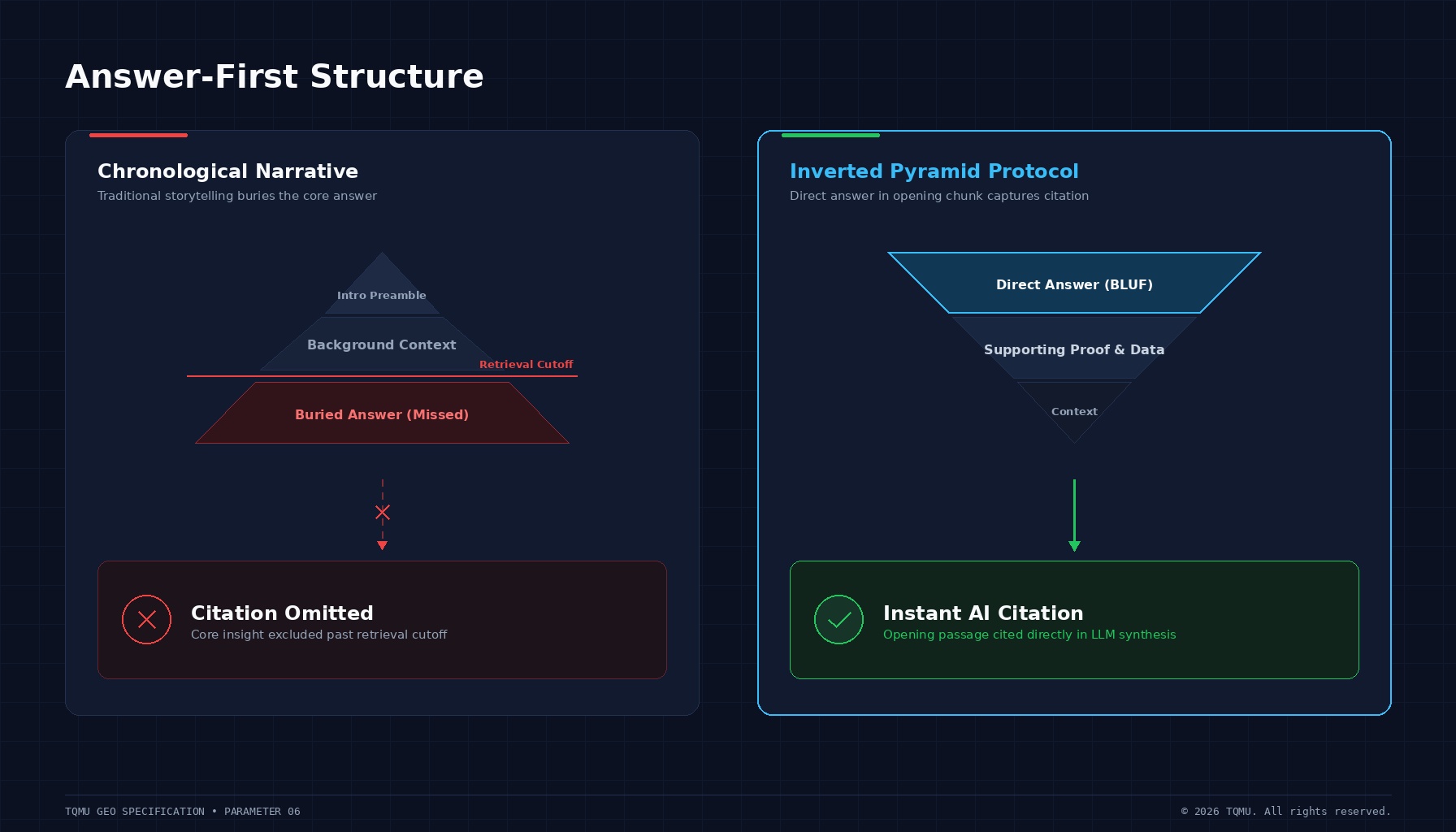
The Answer-First Paradigm: Structuring Inverted Pyramid Content for Direct LLM Retrieval
Why buried answers fail in generative search: how inverted pyramid structure and 40–60 word answer blocks secure direct AI citations in ChatGPT, Perplexity, and Google AI Overviews.
Nov 17, 2026 · 14 min read
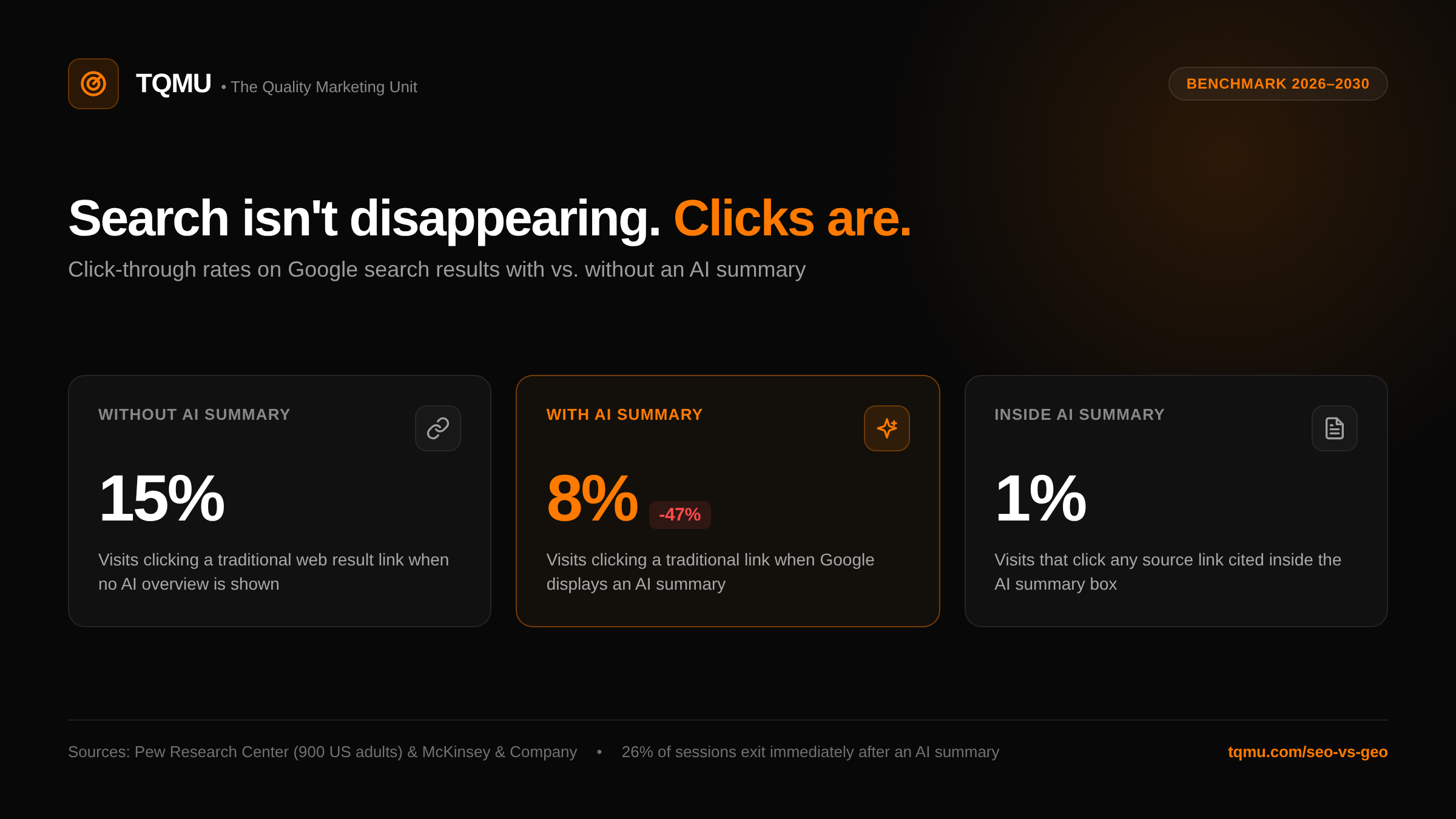
Search Isn't Disappearing, but Your Clicks Are
SEO vs GEO key metrics and outlook, 2026–2030. Updated November 2026 with research, analyst and reference sources only.
Nov 16, 2026 · 4 min read
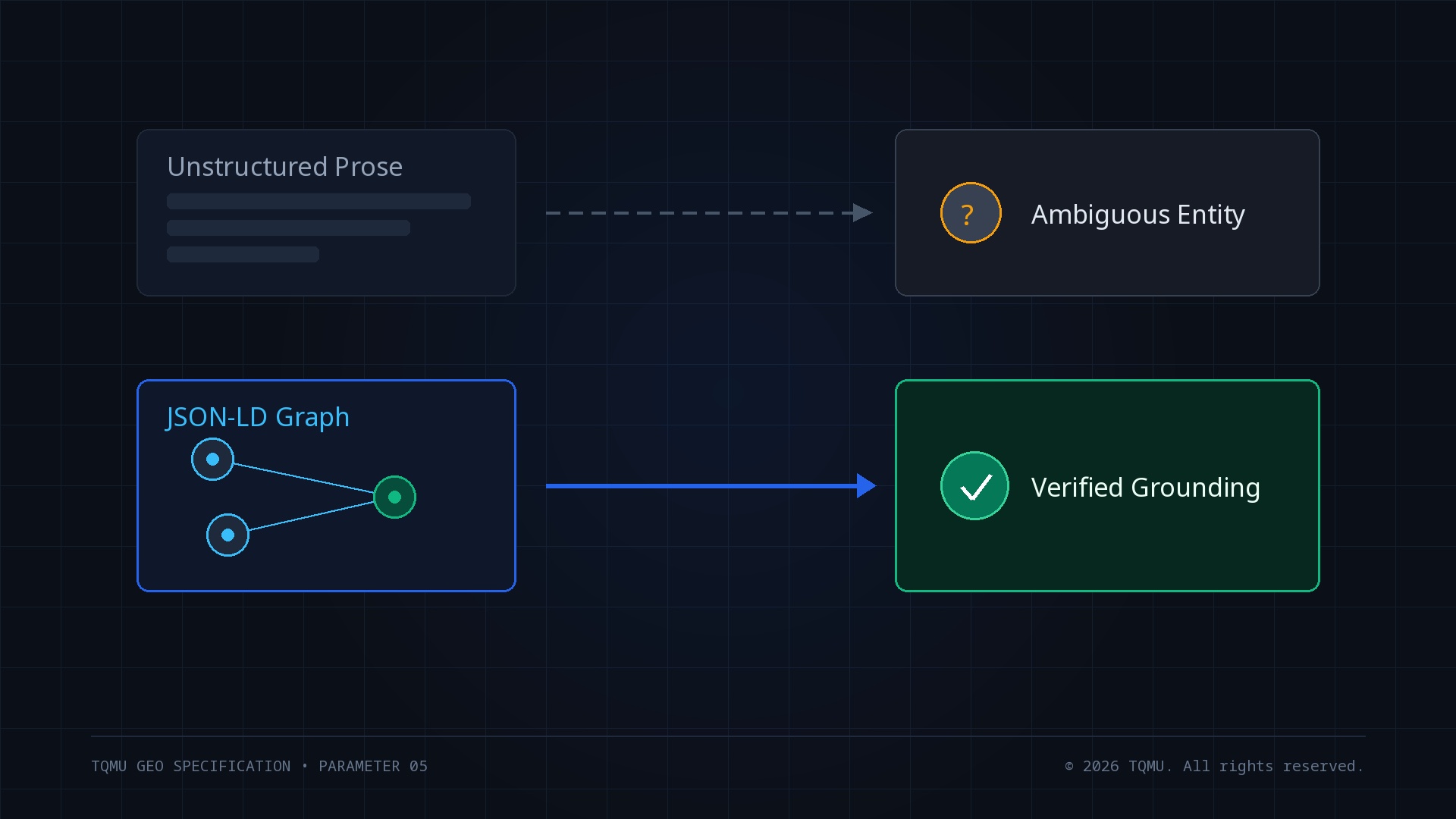
Schema.org JSON-LD Architecture: Building Machine-Readable Knowledge for Generative Search
A technical engineering guide to building disambiguated, machine-readable JSON-LD entity graphs for AI retrieval engines like ChatGPT, Perplexity, and Gemini.
Nov 14, 2026 · 12 min read